
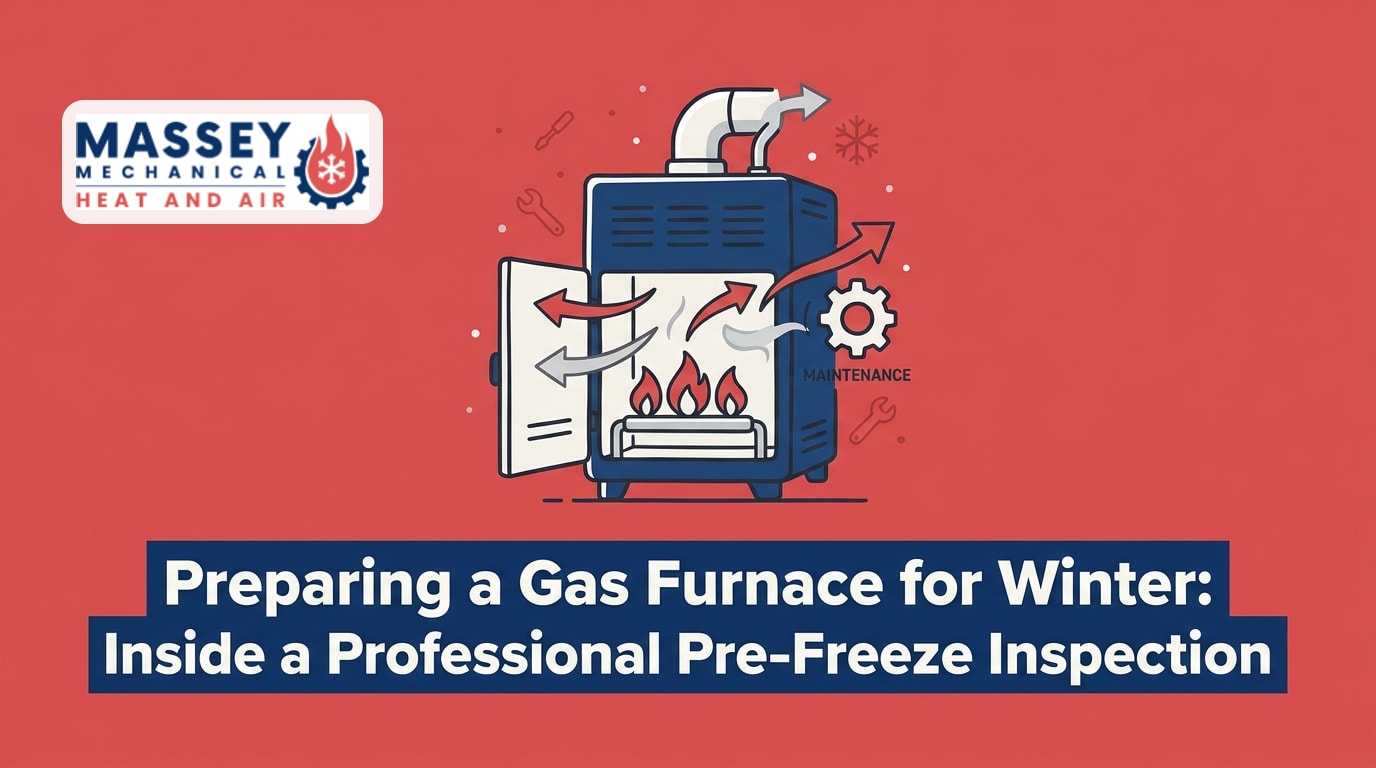
Preparing a Gas Furnace for Winter: Inside a Professional Pre-Freeze Inspection
Surviving the First Freeze: Why Dormant Furnaces Fail in November
Late fall in Central Arkansas is just around the corner, making right now the critical window for preparing a gas furnace for winter before the overnight temperatures plummet. Heating systems sitting dormant all summer accumulate layers of dust, pet hair, and ambient moisture. This long period of inactivity frequently leads to hidden ignition issues and venting blockages that remain completely unnoticed during the warmer months.
If you need comprehensive heating services, scheduling an evaluation before the cold weather hits is the smartest move you can make.
These latent mechanical problems have a distinct pattern: they almost always manifest as sudden heating failures precisely when the first overnight freeze hits in late fall or pre-winter November. The sudden transition from mild, sunny days to freezing nights shocks dormant systems. One local homeowner experienced this exact situation last autumn when a sudden temperature drop caused an unexpected overnight heating failure. A technician arrived within hours of the urgent request, diagnosing a dormant-season issue and getting the heat back up and running before the house grew completely cold.
As a homeowner, you face a distinct decision point every fall. You must choose between relying solely on basic DIY winter prep or scheduling a comprehensive mechanical inspection. While changing your air filter is a great start, a proper pre-winter evaluation ensures the system is mechanically sound, electrically safe, and ready to operate under sudden heavy loads.
Essential Homeowner Checks vs. Professional Boundaries
There is a clear line between the safe, necessary maintenance steps a homeowner should take and the hazardous mechanical checks that require a licensed professional. Understanding this boundary protects your equipment, maintains your manufacturer warranty, and most importantly, keeps your household safe.
Safe DIY Pre-Winter Steps
Basic homeowner preparation focuses on airflow, thermostat communication, and ambient safety. These are steps you should take every late fall or pre-winter November:
• Replacing air filters: Swap out 1-inch or media air filters to ensure proper airflow. A clogged filter forces the blower motor to work harder, increasing energy consumption and risking an overheat shutdown.
• Testing the thermostat: Verify that the thermostat communicates properly with the furnace before freezing temperatures arrive. Switch the setting to "Heat" and raise the temperature a few degrees to ensure the system engages.
• Clearing vents: Ensure all return and supply registers are unblocked. Move rugs, heavy furniture, or drapes that might have been shifted over vents during the summer.
• Testing safety alarms: Check and replace the batteries in all carbon monoxide and smoke detectors. This is a non-negotiable early-season safety step for any home with gas appliances.
The Danger of Opening the Cabinet
Modern gas furnaces are not simple appliances. They contain complex, high-voltage electrical components and combustible gas lines that present severe safety risks if mishandled. The U.S. Department of Energy strongly advises professional maintenance for these internal components, and for good reason.
Attempting to clean internal sensors, adjust gas valves, or inspect heat exchangers without proper licensing and training can easily cause dangerous gas leaks. Furthermore, touching high-voltage blower motors or hot surface igniters carries a significant risk of electrical shock. Beyond the immediate physical dangers, unauthorized tampering will almost certainly void your manufacturer's warranty.
• Replacing Air Filters — Who Should Perform It: Homeowner — Why It Matters: Maintains proper airflow and prevents the system from overheating.
• Testing Carbon Monoxide Alarms — Who Should Perform It: Homeowner — Why It Matters: Provides critical early warning for potential exhaust leaks.
• Cleaning Flame Sensors — Who Should Perform It: Licensed Professional — Why It Matters: Requires specialized tools to avoid damaging the delicate sensor rod.
• Inspecting Heat Exchangers — Who Should Perform It: Licensed Professional — Why It Matters: Requires combustion analysis tools to detect microscopic, dangerous cracks.
Evaluating the Heat Exchanger and Burners for Winter Safety
The heat exchanger is arguably the most critical safety component within your entire heating system. It acts as the physical barrier between the toxic, combustible gases used to create heat and the clean breathing air circulating through your home's ductwork. As long as this metal shield remains intact, the exhaust safely vents outside.
However, years of expanding and contracting during heating cycles can stress the metal. Even microscopic cracks or small rust holes in the heat exchanger can allow deadly carbon monoxide to leak directly into the airstream during operation. Because these cracks are often invisible to the naked eye, a quick visual glance with a flashlight is never enough.
Professionals use specialized combustion analysis tools and flexible visual inspection cameras to snake deep into the system and verify heat exchanger integrity. They measure the exact composition of the exhaust gases to detect any anomalies that indicate a breach.
Alongside the heat exchanger, the burners must be meticulously inspected and cleaned. Over the summer, dust and moisture can cause surface rust on the burner ribbons. If left uncleaned, this debris disrupts the gas flow, leading to a yellow, lazy flame instead of a steady, efficient blue flame. A poor burn creates excess soot buildup and can cause delayed ignition—a startling condition where gas pools in the chamber before igniting with a loud, dangerous "boom."
Precision Measurements: Flame Sensors and Gas Pressure
Generic checklists often mention "cleaning the furnace," but a true professional inspection relies on exact mathematical measurements. Technicians do not just look at components to see if they appear functional; they use calibrated instruments to verify that flame sensor microamps and manifold gas pressure fall exactly within the manufacturer's specified safety ranges.
If you have ever wondered why heating systems crash on the coldest night, it often comes down to these highly sensitive, uncalibrated components failing under continuous stress.
Reading Flame Sensor Microamps
The flame sensor is a vital safety device that tells the control board whether a fire has successfully ignited. If the gas valve opens but no flame is detected, the sensor immediately shuts down the system to prevent raw gas from flooding your home.
1. The Oxidation Problem: Summer humidity often leads to light oxidation and soot buildup on the sensor rod. A dirty flame sensor will cause a furnace to short-cycle, firing up for a few seconds and then abruptly shutting down.
2. The Measurement: Professionals do not just wipe the sensor down; they use a digital multimeter wired in series to read the electrical current in microamps.
3. The Verification: They verify that the microamp reading matches the exact specifications required by the control board, ensuring the system will not falsely lock out during a freezing night.
Calibrating Manifold Gas Pressure
Gas pressure must be perfectly balanced. If the pressure is too high, the furnace is over-firing. This wastes fuel, creates excessive heat, and dramatically accelerates the cracking of the heat exchanger. If the pressure is too low, the furnace is under-firing, which causes condensation inside the chamber, leading to severe rust and corrosion.
1. Testing the Flow: Technicians attach a highly sensitive tool called a manometer to the gas valve to test the exact pressure of the gas flowing to the burners.
2. Adjusting to Spec: They compare this reading to the furnace's data plate specifications.
3. Fine-Tuning: The valve is then carefully adjusted to ensure the perfect fuel-to-air ratio, maximizing both the longevity of the equipment and the safety of the household.

Ensuring Proper Exhaust and Fail-Safe Operation
Creating heat is only half the job; safely exhausting the toxic byproducts is the other. Flue pipes and venting systems must be completely clear of debris, bird nests, or corrosion that may have accumulated over the summer. Improper venting causes a dangerous condition called backdrafting, where carbon monoxide and exhaust gases spill back into the utility room or living spaces instead of venting through the roof.
To protect against venting failures and overheating, modern furnaces are equipped with multiple safety limit switches. The high-limit switch monitors the internal temperature of the cabinet, while the pressure switch ensures the draft inducer motor is successfully pulling exhaust out of the chamber. Roll-out switches sit near the burners to detect if flames are spilling backward.
A professional inspection involves intentionally testing these fail-safes. Technicians will restrict airflow or simulate a draft failure to guarantee these switches trigger correctly and cut power to the gas valve. You need to know these fail-safes will work during a mid-winter malfunction.
One local family experienced a related issue mid-winter when a critical heating component failed, leaving them in the cold. They needed fast HVAC repair in Greenbrier, and technicians arrived the very next day. By providing complete transparency on the needed parts and the mechanics of the failure, the team successfully fixed the heating issue and restored the home's safety systems to full working order.
The "First Freeze" Stress Test: Preparing for Extreme Drops
Contextualizing these technical checks within the reality of regional weather patterns reveals exactly why proactive readiness matters. A furnace that works perfectly fine during a mild 50-degree test run in October may still fail completely when forced to run continuously during a 20-degree overnight freeze in November.
Central Arkansas weather is notorious for rapid, extreme temperature transitions. The sudden shift from mild fall days to freezing winter conditions places immense stress on dormant blower motors, run capacitors, and ignition systems. The equipment goes from sitting idle to running at maximum capacity for hours on end. If a capacitor is weak, or a blower motor is straining against a dirty wheel, this "first freeze" stress test will cause it to fail.
Proactive late fall preparation ensures that when the system is heavily taxed, it has the clean airflow, lubricated motors, and perfectly calibrated gas pressure needed to keep up with the demand. This is why choosing a local HVAC company with a thorough, comprehensive inspection process is vital. A deep understanding of Central Arkansas weather patterns allows professionals to catch the subtle, stress-related issues that generic checklists often miss, providing total peace of mind that your system won't break down when you need it most.
Frequently Asked Questions About Winter Furnace Preparation
How do you prep a furnace for winter?
The essential first step is replacing your air filter and testing your thermostat. From there, clear all supply and return vents of furniture or rugs, and replace the batteries in your carbon monoxide detectors. Because the internal mechanical and gas components require specialized tools, the final step of preparation should always be scheduling a professional inspection.
Should I turn my furnace on before winter?
Yes, you should always test your furnace before the first freezing night. Turn the thermostat to "Heat" and raise the temperature a few degrees on a mild fall day. Let it run for at least fifteen minutes to ensure you smell no persistent unusual odors, hear no grinding noises, and feel warm air reliably blowing from the vents.
How do I make sure my furnace is working for winter?
The most reliable way to ensure functionality is through a professional tune-up. While a homeowner can verify that warm air is blowing, only a licensed technician with a combustion analyzer and a manometer can verify that the heat exchanger is intact, the gas pressure is safe, and the exhaust is venting properly.
At what temperature should I turn on my gas furnace?
Most homeowners turn on their heating systems when indoor temperatures drop below 64°F to 68°F. However, for testing purposes, you should briefly turn the system on in early fall regardless of the indoor temperature just to verify that the ignition sequence operates smoothly before severe weather arrives.
What specific components are checked during a gas furnace tune-up?
A comprehensive tune-up evaluates the heat exchanger, burners, flame sensor, gas valve, and safety limit switches. Technicians will measure flame sensor microamps, calibrate manifold gas pressure, inspect the blower motor assembly, and verify that the flue pipe is drafting exhaust gases safely outdoors.
Why is it dangerous to clean a flame sensor yourself?
Flame sensors are delicate, high-voltage components that are easily damaged by improper handling. Using the wrong abrasive material can scratch the sensor rod, rendering it useless, and opening the cabinet exposes you to serious electrical shock and potential gas leaks if surrounding valves are accidentally disturbed.
Securing Your Home's Comfort Before the Cold Arrives
Ultimately, preparing a gas furnace for winter goes far beyond simply changing an air filter. It requires precision diagnostics of gas pressure, electrical components, and venting safety. Understanding exactly what a professional checks—from flame sensor microamps to manifold gas pressure—provides the peace of mind that your system is genuinely safe and reliable. Don't wait for the first November freeze to test your equipment's limits. Secure your home's comfort today by scheduling a comprehensive furnace maintenance plan evaluation, ensuring your family stays warm and safe all season long.
Recent Posts
Customer Testimonials
