%201.jpg)
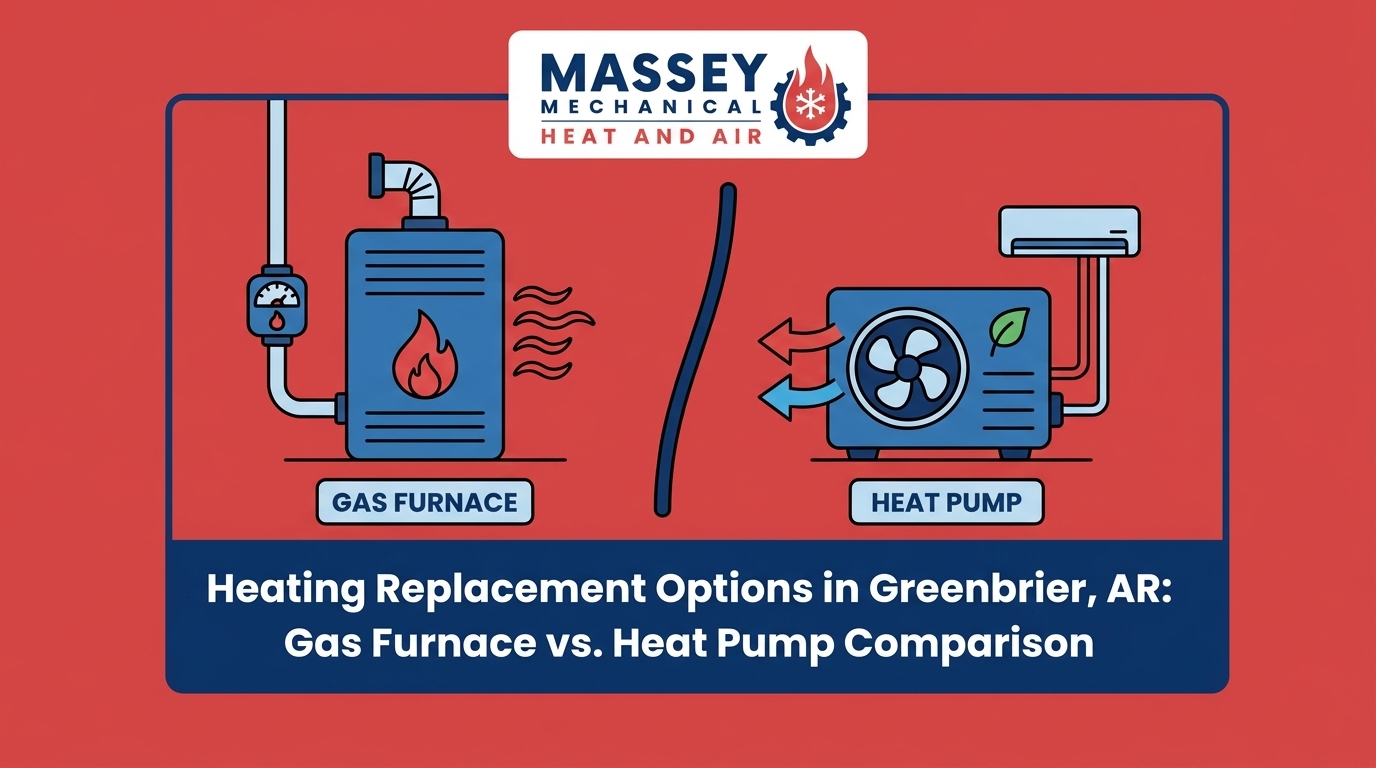
Heating Replacement Options in Greenbrier, AR: Gas Furnace vs. Heat Pump Comparison
Debunking Heating Myths Before the Central Arkansas Winter
At Massey Mechanical Heat And Air, we often encounter a widespread myth circulating among property owners: that modern electrical heating systems fail the moment temperatures drop below freezing. When our team helps customers navigate options comparisons for homeowners, starting with facts rather than outdated fiction is essential. Deciding whether to repair an aging traditional gas furnace or upgrade to a modern heat pump system is a significant choice, especially as the Central Arkansas winter approaches. Making this decision requires a neutral, technical understanding of mechanical reliability and operational efficiency.
For more foundational information on how these systems operate, explore our comprehensive guide on upgrading to a mini split system.
Historically, early generation heat pumps struggled to extract heat from frigid air, leading to a lingering misconception that they are unsuitable for freezing conditions. However, in our years of installing and servicing equipment in Greenbrier AR, we have seen heating technology advance drastically. Today, evaluating your equipment means looking past these old assumptions and focusing on how modern systems actually perform. Whether you are dealing with a standard central ducted system or exploring ductless technology as a viable alternative for specific heating challenges, our goal is to help you secure reliable, efficient warmth.
As you prepare for the colder months, objective evaluation is critical. We consistently see that a rushed emergency installation in the middle of a freeze often limits your choices and forces a quick replacement of whatever system you currently have, rather than allowing you to select the best long-term solution for your property's specific thermal demands.
The Vulnerability of Aging Systems During the Mid-Fall Transition
The autumn season serves as the critical window for evaluating heating system reliability before emergency breakdowns occur. The initial transition from mild autumn weather to cooler temperatures places sudden, intense stress on dormant mechanical components. After sitting idle through the long summer, your heating equipment must suddenly fire up and operate at peak capacity. This mid-fall heating startup frequently exposes underlying weaknesses that went unnoticed during the warmer months.
During a recent winter season, our technicians at Massey Mechanical Heat And Air responded to a complete system failure when a local homeowner's heater stopped working unexpectedly. We swiftly dispatched a professional technician to the house to diagnose and successfully fix the unit. While we are always ready for emergencies, this type of breakdown is exactly what our proactive fall evaluations aim to prevent.
Before committing to a full system replacement, objective troubleshooting is a necessary first step. Sometimes, what appears to the homeowner to be a catastrophic failure is actually a minor electrical issue. If you are using ductless technology, it helps to check if your mini-split is actually broken before assuming the worst.
Basic Homeowner Steps for Evaluating Your System During the First Fall Startup:
1. Verify the thermostat communication: Ensure the thermostat is set to "heat" and calling for a temperature higher than the current room ambient temperature.
2. Inspect the airflow pathway: Check your air filter. A heavily soiled air filter restricts airflow, causing the system's internal safety switches to trip and shut down the heating cycle prematurely.
3. Listen to the ignition sequence: Pay close attention to the sounds your system makes when it first turns on. Grinding, squealing, or delayed booming sounds indicate mechanical distress that requires a professional.
4. Monitor the cycle length: A healthy system runs in smooth, consistent cycles. If the unit turns on and off rapidly, it is struggling to maintain proper operation.
Identifying Early Warning Signs of Mechanical Failure
When turning on a furnace for the first time in months, our technicians look for specific symptoms that indicate the system is reaching the end of its operational life. Delayed ignition is a serious warning sign in combustion systems, often pointing to dirty burners or a failing ignition module. Short-cycling behavior—where the system runs for only a few minutes before shutting down—frequently indicates potential overheating, airflow restrictions, or a failing blower motor.
Understanding the technical difference between a minor component failure (like a worn capacitor) and end-of-life system degradation (like a cracked heat exchanger) is vital for making an informed replacement decision with your HVAC contractor.
Traditional Gas Furnaces: Mechanical Reliability and Combustion Heating
To make an informed choice, we always provide our customers with a purely technical, unbiased breakdown of how gas furnaces operate. Traditional gas furnaces generate heat through controlled combustion. When the thermostat calls for heat, the gas valve opens, delivering fuel to the burners. An igniter lights the fuel, creating hot combustion gases that travel through a metal component called the heat exchanger. The system's blower motor then pushes indoor air over the outside of this hot metal exchanger, warming the air before distributing it through your ductwork.
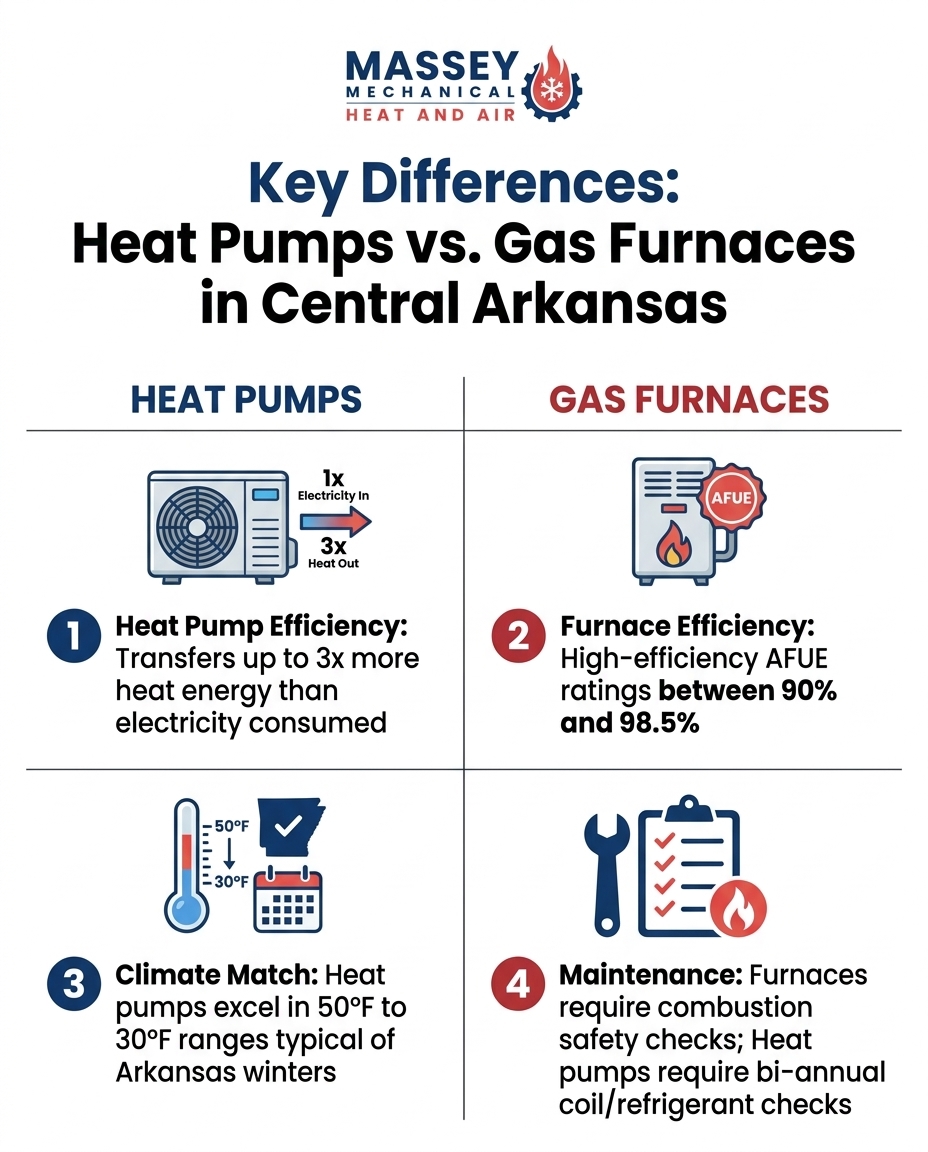
The efficiency of this process is measured by its AFUE (Annual Fuel Utilization Efficiency) rating. Standard older models we replace often operate around 80% AFUE, meaning 20% of the energy consumed is lost as exhaust out the flue. High-efficiency modern models achieve between 90% and 98.5% AFUE by utilizing a secondary heat exchanger to capture condensing exhaust gases, converting nearly all the fuel into usable heat for your home in Greenbrier AR.
The lifespan expectations of traditional furnaces are typically driven by the integrity of the heat exchanger. Over years of expanding and contracting with heat, the metal can fatigue and crack. Because a cracked heat exchanger risks leaking carbon monoxide into the living space, it usually signals the end of the furnace's safe operational life.
Pros and Cons of Combustion Heating
• Advantage: Rapid Heat Delivery — Impact on Home Comfort and Safety: Combustion produces very high temperatures quickly, resulting in hot air at the register that warms a cold house rapidly.
• Advantage: Ambient Independence — Impact on Home Comfort and Safety: Because it burns fuel internally, a furnace's heating capacity is completely unaffected by how cold the outdoor air becomes.
• Disadvantage: Safety Monitoring — Impact on Home Comfort and Safety: Requires strict, ongoing carbon monoxide monitoring, routine flue inspections, and careful ventilation maintenance to ensure safe exhaust.
• Disadvantage: Single-Season Use — Impact on Home Comfort and Safety: Furnaces only provide heating; they cannot provide summer cooling, requiring you to maintain a completely separate air conditioning system.
Modern Heat Pumps and Ductless Systems: Unlocking High Efficiency
Unlike gas furnaces that consume fuel to generate heat, modern heat pumps use electricity to transfer heat. They operate using a refrigeration cycle, much like an air conditioner running in reverse. Even when the air outside feels freezing, it still contains ambient thermal energy. A heat pump's outdoor unit extracts this ambient heat from the outside air, compresses the refrigerant to increase its temperature, and transfers that heat indoors.
In another instance during a recent winter, our team received an emergency call from a property that lost heating entirely. Our Massey Mechanical Heat And Air technicians arrived within hours, diagnosed the underlying mechanical issue, and had the heat back up and running swiftly. Fast response times are critical, but having a system that operates efficiently day in and day out is equally important. For homes looking to upgrade, our mini split services in Conway offer a clear path to high-efficiency heat transfer.
Heat pump efficiency is measured by HSPF (Heating Seasonal Performance Factor). Because they move heat rather than creating it from scratch, modern systems can deliver up to three times more heat energy to a home than the electrical energy they consume. This remarkable efficiency multiplier makes them incredibly cost-effective to operate during a typical mid-fall heating startup and throughout the milder portions of winter.
Ductless configurations take this efficiency a step further. By delivering conditioned air directly into specific zones without traveling through uninsulated attic ductwork, ductless systems eliminate the ductwork energy losses that plague traditional central systems. Furthermore, the mechanical simplicity of having a single piece of equipment handle both heating and cooling year-round streamlines your property's infrastructure.
How Inverter Technology Maximizes Comfort
The secret to modern heat pump performance lies in inverter technology. Older heating systems use single-stage compressors, meaning they are either running at 100% capacity or turned off completely. This creates harsh on/off cycling and noticeable temperature swings.
• Variable-speed operation: Inverter-driven compressors adjust their output precisely to match the real-time heating load of the home, operating at anywhere from 30% to 100% capacity.
• Eliminated temperature swings: By running continuously at a lower speed, the system eliminates the harsh on/off cycling associated with traditional single-stage systems.
• Consistent comfort: This technology maintains consistent indoor temperatures with a significantly lower electrical draw, operating much like a car maintaining a steady speed on the highway rather than constantly stopping and starting in traffic.
Navigating Extreme Temperature Swings in Central Arkansas
To make the best choice for your property, our team always analyzes the local winter profile with you. Central Arkansas winter temperatures frequently fluctuate between mild 50-degree days and sudden freezing overnight lows. This specific climate dynamic tests traditional furnace cycling while maximizing heat pump efficiency.
During the mild 50-degree afternoons common in Greenbrier AR, a traditional gas furnace is often overpowered for the heating demand. It turns on, blasts high heat for a few minutes, satisfies the thermostat, and shuts off. This short-cycling reduces efficiency and increases wear on the blower motor. In contrast, a heat pump thrives in 50-degree weather, easily transferring abundant ambient heat indoors with minimal electrical effort.
For roughly 80% of the local winter season, this climate maximizes heat pump efficiency without overworking the compressor. However, performance during the coldest 20% of the season—when overnight lows drop below freezing—requires specific planning. Modern heat pumps handle these drops well, but they are often paired with supplemental electric heat strips that activate automatically if the system needs a boost. Alternatively, dual-fuel configurations pair a heat pump with a gas furnace, using the heat pump for mild weather and automatically switching to gas combustion only during extreme freezes.
If you live in the Conway service area or surrounding regions, understanding how your equipment handles these specific swings is the key to long-term comfort.
• Mild (45°F - 60°F) — Gas Furnace Performance: Prone to short-cycling; overpowered for the low heating demand. — Heat Pump Performance: Maximum efficiency; operates at low speeds with minimal energy draw.
• Cold (30°F - 45°F) — Gas Furnace Performance: Steady operation; delivers consistent, fast heat to the living space. — Heat Pump Performance: High efficiency; inverter technology easily maintains set temperatures.
• Freezing (Below 30°F) — Gas Furnace Performance: Peak performance; unaffected by outdoor ambient conditions. — Heat Pump Performance: Requires more energy to extract heat; may utilize supplemental heat strips.
Long-Term Value, Maintenance, and Energy Incentives
When evaluating the long-term ownership experience, maintenance requirements differ significantly between system types. Whether you are scheduling a routine mid-fall heating startup or booking an AC repair in Conway, understanding what your equipment needs to survive is essential.
• Furnace Maintenance Requirements: Gas furnaces demand strict annual combustion safety checks. Technicians must inspect the heat exchanger for hairline cracks, verify proper gas pressure, clean the flame sensor, and ensure the flue is venting carbon monoxide safely outdoors.
• Heat Pump Maintenance Requirements: Because heat pumps handle both heating and cooling, they run year-round and require bi-annual maintenance. Technicians must check refrigerant charge levels, clean the outdoor condenser coils, and verify the operation of the reversing valve that switches the system between cooling and heating modes.
• Energy Incentives: Upgrading to high-efficiency electric systems often qualifies for generic federal tax credits and utility incentive programs. Homeowners should verify current programs with their local utility provider or a tax professional to understand what efficiency ratings are required to qualify.
• Environmental Impact: There is a distinct difference between on-site fossil fuel combustion (furnaces) and electrical heat transfer (heat pumps). Heat pumps produce zero direct emissions at the property level, shifting the energy source to the electrical grid.
Ultimately, proper, professional sizing and installation are the biggest factors in mechanical longevity for either system type. An improperly sized furnace will short-cycle itself to an early grave, while an improperly charged heat pump will struggle to maintain temperature and burn out its compressor.
Making Your Final Heating Upgrade Decision
The best choice for your property in Greenbrier AR depends on several structural variables, including the condition of your existing ductwork, your specific efficiency goals, and your long-term homeownership plans. If your home lacks ductwork entirely, our team often recommends a ductless mini-split heat pump as the clear winner. If you already have a robust gas line and newer ductwork, a high-efficiency furnace remains a powerful, reliable option.
As the mid-fall weather transitions into deeper cold, now is the time to schedule a professional, unbiased assessment of your current heating infrastructure with Massey Mechanical Heat And Air. Relying on a team with reliable emergency dispatch capabilities and specific expertise with both traditional combustion and ductless systems in the area ensures you get an objective recommendation.
Do not wait for a complete mechanical failure in the dead of winter. Secure expert guidance today, evaluate your property's specific thermal needs, and make an informed upgrade decision before deep winter weather arrives.
Frequently Asked Questions
Is it better to have a heat pump or a gas furnace in Arkansas?
In our experience serving Central Arkansas, the ideal choice depends heavily on your home's existing infrastructure and your efficiency goals. Because Arkansas winters feature long stretches of mild temperatures in the 40s and 50s, heat pumps operate with exceptional efficiency for the majority of the season. However, homes with existing gas lines and older, drafty insulation may still benefit from the rapid, high-temperature heat delivery of a modern gas furnace.
At what temperature does a heat pump become inefficient?
Older heat pumps typically began losing efficiency around 35°F, but modern inverter-driven models can efficiently extract heat in temperatures well below freezing. When temperatures drop into the low 20s or teens, the system requires more electrical energy to transfer heat and may activate supplemental electric heat strips to maintain indoor comfort. Despite this, their overall seasonal efficiency remains extremely high.
Should I replace my aging gas furnace with a heat pump?
Replacing an aging furnace with a heat pump is a smart upgrade if you want to consolidate your heating and cooling into a single, highly efficient system. This switch eliminates on-site combustion and carbon monoxide risks while taking advantage of modern inverter technology. A professional load calculation is necessary to ensure your existing ductwork can handle the airflow requirements of a heat pump.
How long do heat pumps last compared to traditional gas furnaces?
Traditional gas furnaces typically last between 15 and 20 years, largely because they only operate during the winter months. Heat pumps generally have a lifespan of 12 to 15 years because they run year-round, handling both summer cooling and winter heating. Consistent, bi-annual maintenance is the most critical factor in maximizing the lifespan of either system.
Can a ductless mini-split system heat an entire house?
Yes, a properly designed multi-zone ductless system can effectively heat an entire home. By connecting multiple indoor air handlers to a single outdoor compressor, you can create customized heating zones throughout the property. This setup eliminates the energy loss associated with leaky ductwork and allows you to stop paying to heat unoccupied rooms.
What are the maintenance differences between combustion furnaces and heat pumps?
Combustion furnaces require annual safety inspections focused on the heat exchanger, gas pressure, and carbon monoxide venting. Heat pumps require bi-annual maintenance (spring and fall) to inspect refrigerant levels, clean the evaporator and condenser coils, and test electrical components. Because heat pumps operate continuously throughout the year, keeping their coils clean is vital for maintaining heat transfer efficiency.
Customer Testimonials
