%201.jpg)
The First-Freeze Furnace Failure: Why Central Arkansas Heating Systems Crash on the Coldest Night

The Shock of the Cold: Confronting First-Freeze Furnace Failures
September in Central Arkansas brings a welcome shift in the weather, but it also sets the stage for what our technicians at Massey Mechanical Heat And Air call The First-Freeze Furnace Failure: Why Central Arkansas Heating Systems Crash on the Coldest Night. In our experience serving Greenbrier and the surrounding communities, the transition from late summer to early fall is notoriously deceptive. We often experience beautifully mild, breezy days that mask the sudden, sharp overnight temperature drops looming just around the corner. When that first unpredictable freeze finally arrives, thousands of homeowners walk over to their thermostats, switch the system to heat, and wake up hours later shivering in a freezing house.
This widespread phenomenon happens because furnaces experience mechanical lockouts on the very first freezing night after sitting completely dormant for months. The sudden demand placed on cold, stiffened components triggers safety mechanisms that shut the entire system down. This leaves you facing a critical decision point right now, during the mild September pre-heating season: you can either wait until your house is freezing to turn on the heat and cross your fingers, or you can proactively run a controlled, 15-minute test run today to verify your system's operational status.
Uncovering a mechanical problem early prevents you from spending an uncomfortable, freezing night waiting for emergency repairs. If you need professional assistance establishing a baseline for your equipment, our comprehensive Heating Services are designed to catch these exact issues. Should you find yourself caught off guard by a sudden breakdown, you can rely on our 24-hour furnace repair in Benton to restore your comfort quickly and safely.
Understanding the Central Arkansas Climate Shift
The specific climate patterns in our area create a unique challenge for residential climate control. Unlike northern regions where the cold rolls in gradually and stays, our local weather can swing wildly. A week of eighty-degree afternoons can immediately precede a night where temperatures plummet below freezing. This rapid environmental shift creates a phenomenon known as thermal shock for your equipment.
The mechanics of the shift:
• Rapid contraction: Metal components that have expanded during months of hot weather suddenly contract as the ambient temperature drops.
• Lubricant thickening: The oils and greases that keep internal motors spinning freely become highly viscous and stiff in the sudden cold.
• Moisture condensation: Rapid temperature drops can cause residual humidity trapped inside the cabinet to condense on sensitive electronic boards.
When you demand a heavy, immediate heating load from a system experiencing these sudden changes, the mechanical stress is immense. Testing the system during the September pre-heating season allows these components to wake up gradually under a mild load, significantly reducing the risk of a catastrophic failure on the coldest night of the year.
Summer Dormancy: The Hidden Toll on Your Heating Equipment
To understand why systems fail so predictably in the fall, you have to look at what happens during the summer. Our team typically sees furnaces that have sat completely unused for five to six months during the long, hot Southern cooling season. While your air conditioner is working overtime to battle the heat, the heating components inside your HVAC system are resting in total darkness and silence. We've found this extended dormancy is the root cause of almost every early-season breakdown.
During this long period of inactivity, the high humidity characteristic of an Arkansas summer infiltrates the equipment cabinet. This airborne moisture interacts with the metal components, while the lack of mechanical movement allows dust, pet dander, and microscopic debris to settle deep within the unit's moving parts. When a sudden, heavy load is demanded on the first cold night, these stiffened, dusty parts resist operation. The system senses this resistance and triggers a safety lockout to protect itself from damage.
The Physical Impact of Inactivity
The transition from cooling to heating is the most vulnerable time for your entire climate control setup. Moving parts that rely on regular rotation to stay lubricated suddenly find themselves locked in place. Electrical contacts that need a clean surface to pass voltage become coated in an invisible layer of resistance.
• Blower Motor Bearings — Condition During Summer Dormancy: Lubricants settle at the bottom of the bearing housing due to gravity and lack of rotation. — Result on the First Freezing Night: High friction upon startup, leading to overheating and potential motor failure.
• Burner Assembly — Condition During Summer Dormancy: Spiders and insects build webs; dust settles thickly across the gas ports. — Result on the First Freezing Night: Uneven ignition, delayed ignition (a loud "boom"), or failure to light entirely.
• Electrical Relays — Condition During Summer Dormancy: High humidity causes microscopic oxidation on the copper contact points. — Result on the First Freezing Night: Voltage fails to pass through the switch, resulting in a system that clicks but won't start.
• Draft Inducer Wheel — Condition During Summer Dormancy: Moisture from summer humidity causes light rust on the wheel and housing. — Result on the First Freezing Night: The wheel scrapes or seizes entirely, preventing the safety sequence from beginning.
By executing a test run during the September pre-heating season, you force these components to move, burn off the settled dust, and clear the microscopic oxidation before the cold weather permanently sets in.
Flame Sensors and Inducer Motors: The Mechanics of a Lockout
When our dispatchers receive a frantic call about a furnace locking out, we usually don't find that a major component has shattered. Instead, the failures our technicians diagnose are almost always tied to the delicate safety sensors that govern the ignition sequence. Dust accumulation and minor oxidation on flame sensors are leading causes of ignition failure after prolonged dormancy. These components are incredibly sensitive, and they must be to keep your home safe.
If the flame sensor cannot detect a flame due to a microscopic layer of oxidation or baked-on dust, the system shuts down the gas valve within seconds to prevent raw gas from building up in your home. This is a critical safety feature working exactly as designed. However, it results in a freezing house if the underlying oxidation isn't addressed. Understanding these furnace safety concerns helps clarify why professional maintenance is so valuable.
The Inducer Motor: The First Line of Defense
Before the gas valve ever opens, the inducer motor must prove that it can safely vent exhaust gases out of your home. This small motor creates a draft that pulls toxic combustion byproducts through the heat exchanger and out the flue. Because this motor sits idle for half the year, it is highly susceptible to seizing up from rust or stiff bearings.
The Problem: The thermostat calls for heat, but the inducer motor is physically stuck due to summer dormancy. The Cause: High humidity has caused the internal bearings to oxidize, or a wasp has built a nest inside the exhaust flue, blocking the fan blade. The Solution: The system's pressure switch detects that the inducer is not moving air. It immediately halts the ignition sequence. The furnace will not attempt to light, and it will flash a diagnostic code indicating a draft failure. This prevents carbon monoxide from spilling into your living space.
The Flame Sensor: The Final Verification
If the inducer motor starts successfully, the igniter glows, and the gas valve opens. At this exact moment, the flame sensor takes over. This thin metal rod sits directly in the path of the burner flame.
The Problem: The burners ignite beautifully, but three seconds later, they shut off completely. The blower fan runs for a few minutes blowing cold air, and then the system goes silent. The Cause: The flame sensor is coated in a thin layer of silica (from airborne dust) or oxidation from the humid summer. When the flame hits the sensor, the coating acts as an insulator, preventing the microamp electrical current from passing through the flame back to the control board. The Solution: The control board assumes there is no flame and that raw gas is pouring into the cabinet. It slams the gas valve shut to prevent an explosion. The system locks out after three failed attempts. These safety mechanisms protect your property, but they require a clean environment to function properly during the September pre-heating season.
Executing the 15-Minute September Test Run Protocol
As local HVAC professionals, we always advise our customers that bridging the gap between early fall and peak winter requires proactive action. You do not need to be a mechanical expert to verify that your system is ready for the cold. By following a highly specific, actionable testing protocol we recommend, you can safely trigger any latent lockouts on your own terms.
This controlled test should be performed during the September pre-heating season. Choose a mild afternoon before the first unpredictable October or November freeze hits our region. By testing when the outside temperature is still comfortable, you eliminate the stress and urgency of an emergency breakdown.
The Step-by-Step Testing Protocol
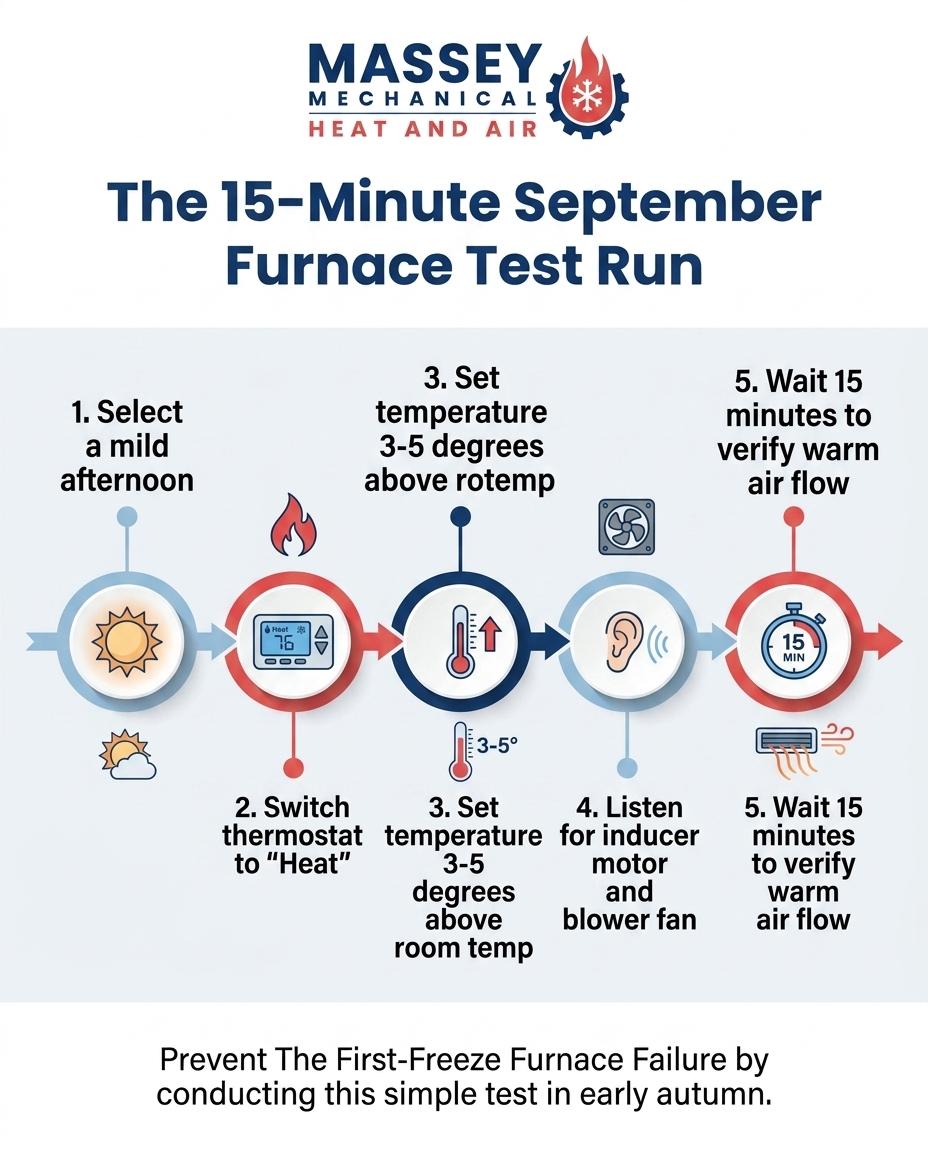
1. Select the right time: Choose a mild day where opening the windows won't make the house uncomfortably cold. You want to perform this test when you have plenty of daylight and local service companies are open for standard business hours.
2. Adjust the thermostat: Switch your thermostat from "Cool" or "Off" to the "Heat" position. Set the target temperature exactly three to five degrees above the current room temperature. This is enough of a temperature differential to force the system to turn on immediately without making your house sweltering hot.
3. Listen for the sequence of operations: Stand near the furnace cabinet (usually in the hallway, garage, or attic) and listen closely. You should first hear a small motor hum to life (the inducer motor). A few seconds later, you should hear a distinct click, followed by the soft "whoosh" of the gas burners igniting. Finally, about thirty to sixty seconds later, the large main blower fan will engage.
4. Let the system run: Allow the equipment to operate continuously for a full 15 minutes. This duration is critical. It gives the burners time to burn off the settled dust that has accumulated over the summer. You should expect a brief, distinct burning smell from the vents during the first five minutes—this is completely normal. Walk to the nearest supply register and verify that strong, warm air is flowing steadily.
5. Complete the test: If the system operates smoothly for the entire 15-minute window, the burning smell dissipates, and the house begins to warm up, you can confidently turn the thermostat back to your preferred setting. Your system has successfully cleared its summer dormancy and is ready for the winter ahead.
Interpreting Your Test Results: When to Call for Backup
Not every test run ends with warm air and peace of mind. If your system struggles during the September pre-heating season, it is vital to recognize the warning signs and know exactly how to respond. A failed test is not a disaster; in fact, a failed test is actually a massive success. You have successfully exposed a hidden mechanical issue on a mild afternoon rather than discovering it at midnight during a freezing storm.
If you switch the thermostat to heat and the system simply clicks but fails to ignite, or if the burners light for two minutes and immediately shut off, you have triggered a mechanical lockout. You might also notice the main blower fan running endlessly while blowing completely cold air from the registers. These symptoms indicate that one of the safety sensors has detected a fault and halted the heating cycle.
Next Steps After a Failed Test
When a lockout occurs, do not attempt to repeatedly restart the system by toggling the thermostat on and off. While resetting the breaker might temporarily clear the error code, it does not fix the underlying oxidation or airflow restriction. More importantly, never attempt to open the cabinet and clean internal oxidized components yourself. Flame sensors and igniters are highly fragile, and improper handling can permanently damage delicate sensors or create severe safety hazards involving the gas line.
Instead, scheduling a professional diagnostic immediately ensures the issue is resolved before emergency conditions arise. Just last fall, our team helped a local homeowner who experienced a similar heating issue right as the temperatures began to drop. Because they noticed the problem early, our technician was able to arrive the very next day. We provided transparent details about the required components, resolved the mechanical fault swiftly, and left the customer with complete peace of mind through an ongoing maintenance membership. Catching the problem early turned a potential emergency into a simple, scheduled visit.
Beating the Rush: The Reality of First-Freeze Dispatch Queues
Understanding the mechanical reasons for a breakdown is only half the battle; understanding the logistical reality of local repair services is the other. When the first sharp freeze hits our region, hundreds of dormant heating systems fail simultaneously across the area. The sudden, intense demand for service creates an immediate bottleneck for every service provider in the state.
At Massey Mechanical Heat And Air, our dispatch boards light up immediately the morning after a freeze. What would normally be a routine, same-day sensor cleaning suddenly turns into a prolonged wait for service. Technicians are routed from neighborhood to neighborhood, parts supply houses experience massive lines, and the sheer volume of calls means that someone has to wait. Homeowners who wait for the cold to test their systems often find themselves at the back of a very long line, huddled under blankets while waiting for their turn on the schedule.
Leveraging the Safety Net in Benton and Cabot
Proactive testing changes this dynamic entirely. When you test early, you beat the rush. You secure a convenient appointment time, and your repairs are completed long before the frost settles on the grass. We see this pattern clearly in neighborhoods across Benton and Cabot every single year. The homes that test early stay warm, while the homes that wait experience the stress of an unexpected breakdown.
Of course, true emergencies still happen, which is why our 24-hour emergency dispatch availability serves as a reliable safety net for sudden, unavoidable failures. Another local customer reached out to us when their heat failed entirely during a cold snap. Because of our dedicated dispatch protocols, our technician was routed to their home within hours of the service request, getting the system back up and running before the house grew completely cold. While it is incredibly reassuring to know that heating repair in Cabot is always available when you need it, proactive testing allows you to utilize this 24-hour availability as a backup plan rather than competing in the midnight rush.
Frequently Asked Questions
Why did my furnace lock out after sitting all summer?
Your furnace locked out because months of dormancy allowed dust to settle and humidity to oxidize sensitive metal components. When the system tried to start, these stiffened or dirty parts triggered built-in safety mechanisms. The control board shuts the system down to prevent damage or gas buildup when it senses resistance.
How do I test my furnace before the first freeze?
Test your furnace by choosing a mild afternoon and setting your thermostat to "Heat," about three to five degrees above the current room temperature. Listen for the system to cycle on, starting with a faint hum, followed by ignition, and finally the blower fan. Let it run for a full 15 minutes to ensure warm air flows consistently from the vents.
How long should I test run my furnace in fall?
You should let your furnace run for exactly 15 minutes during your initial fall test. This duration is long enough to burn off the dust that settled over the summer and allows the system to complete a full heating cycle. If it shuts off prematurely within this window, you likely have a sensor issue requiring professional attention.
What causes a furnace to blow cold air on its first use?
A furnace blows cold air on its first use when the safety sensors detect a fault and shut down the gas burners, but leave the blower fan running to cool the heat exchanger. This is a classic symptom of a mechanical lockout, often caused by a dirty flame sensor or a blocked exhaust flue. The system is protecting itself from overheating or gas accumulation.
Is it normal to smell burning dust when turning on the heater?
Yes, it is completely normal to smell a brief burning odor the very first time you turn on your heater in the fall. This smell is simply the accumulation of summer dust burning off the heat exchanger and burner assembly. The odor should dissipate entirely within the first five to ten minutes of operation.
Can a dirty flame sensor cause a furnace lockout?
Absolutely. A dirty flame sensor is one of the most common causes of a furnace lockout after summer dormancy. If the sensor is coated in dust or microscopic oxidation, it cannot detect the burner flame, causing the system to shut the gas valve off within seconds for your safety.
Prepare Your Home for the Winter Ahead
Don't let The First-Freeze Furnace Failure: Why Central Arkansas Heating Systems Crash on the Coldest Night catch you off guard this year. By understanding the mechanical sequence that causes a dormant furnace to fail and taking 15 minutes to safely test your system now, you guarantee your comfort when the temperatures drop. If your test run reveals a problem, or if you want the ultimate peace of mind, schedule your tune-up before the freezing weather hits. Reach out today to verify your system's operation and keep your family warm all season long.
Customer Testimonials
